
XiangYe / Fragrance Knowledge
How Do Scent Diffusers Work?
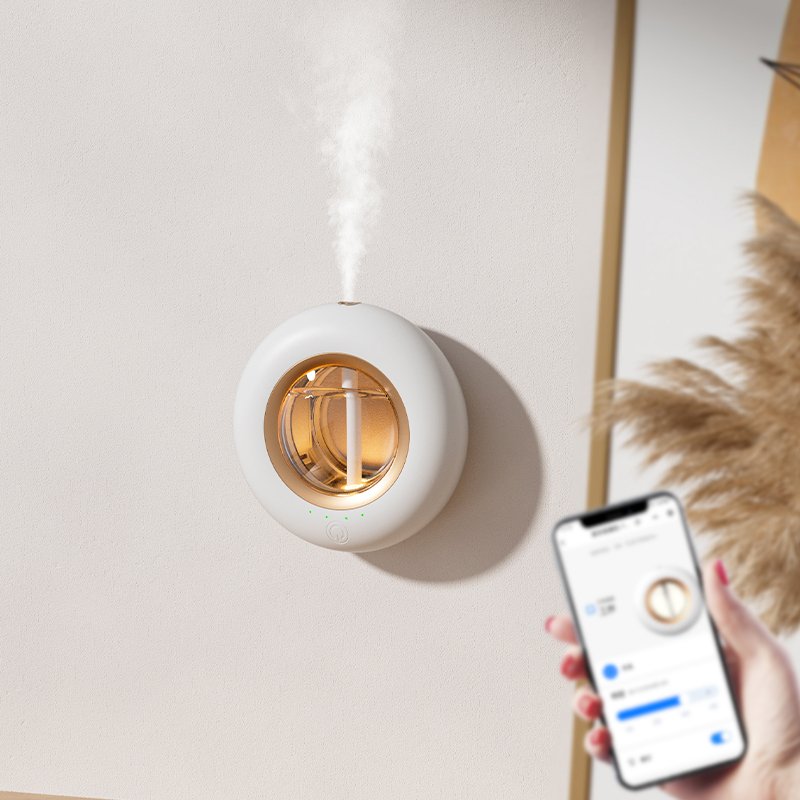
Scent diffusers release fragrance by turning liquid into fine droplets or allowing it to evaporate. Cold-air machines use airflow, ultrasonic diffusers usually create mist from water, and reeds release scent without electricity. Room airflow then carries the fragrance. This guide explains each method and what changes its performance.
Quick Reference
| Diffuser type | How it releases fragrance | Main operating requirement |
|---|---|---|
| Cold-air/nebulizing diffuser | Air-driven atomization of compatible liquid | Approved refill and powered air supply |
| Ultrasonic diffuser | Vibrations create mist from a water-based reservoir | Correct water level and approved fragrance dosage |
| Reed diffuser | Liquid rises through reeds and evaporates | Suitable refill and exposed reeds |
| Fan-based evaporative diffuser | Air passes over a scented carrier | Compatible pad or cartridge and fan power |
| Heat-based diffuser | Warming encourages evaporation | Matching heater and fragrance format |
HVAC scenting commonly distributes fragrance produced by a connected diffuser through building ventilation. It describes the delivery route, rather than an additional liquid-release technology. Start by identifying the release mechanism; then consider how the scented air reaches people.
What Is a Scent Diffuser or Aroma Diffuser?

A scent diffuser, often called an aroma diffuser, is a device or arrangement designed to introduce fragrance into its surroundings. The name covers both simple reed bottles and programmable commercial equipment. Understanding any model is easier when you separate three things: the fragrance preparation, its release mechanism, and the movement of air.
- The device: exposes a scented surface, creates droplets, or supplies heat to release fragrance.
- The carrier: may be a liquid formulation, water-based reservoir, porous reed, pad, or cartridge.
- The room: transports and dilutes fragrance through moving air; the device does not control every airflow.
- The application: determines whether localized fragrance, scheduled output, or connected-zone distribution is useful.
What You Will Learn
- How each mechanism releases fragrance.
- Why room volume and airflow change coverage.
- How settings and refill compatibility affect operation.
- Which maintenance checks help explain disappointing results.
A diffuser primarily adds scent. A humidifier primarily adds moisture, while an air purifier is designed to remove specified airborne contaminants. One product may combine functions, but scent output alone establishes neither purification performance nor meaningful humidity control.
How Does Fragrance Move Through the Air?

Atomization divides a liquid into droplets; it does not split fragrance molecules apart. Evaporation is different: substances leave a liquid surface and enter the gas phase. An atomizing diffuser can produce droplets that subsequently lose volatile ingredients by evaporation, so airborne fragrance is not necessarily all vapor or all droplets.
- Release begins: fragrance leaves the reservoir or moves into an exposed carrier such as a reed.
- Liquid or surface interaction: the device emits droplets, or fragrance evaporates from the exposed material.
- Transport follows: moving air carries fragrance beyond the outlet, bottle, or cartridge.
- Concentration changes: ventilation removes or dilutes fragrance, droplets may deposit, and continued operation replenishes output.
- People notice it: perceived intensity differs with location, exposure history, individual sensitivity, and the fragrance itself.
A visible plume shows only part of this process. Visibility depends on the droplets, lighting, background, and concentration. You cannot reliably judge a machine’s output by looking for a cloud, nor assume that an invisible plume means nothing is being released.
Physical release and odor perception are related but distinct. Someone entering a room may notice a scent that a person already inside barely registers. That difference does not, by itself, prove that the equipment changed output or stopped working.
How Do Waterless and Cold-Air Scent Diffusers Work?

Common commercial cold-air diffusion systems use air-driven nebulization: moving air interacts with a compatible fragrance liquid to form small droplets. The term “cold-air” normally means that deliberate heating is not required for fragrance release. It does not mean the machine refrigerates the air.
- A bottle or reservoir supplies fragrance to the atomizing assembly through the model’s liquid pathway.
- An air pump or compressed-air supply sends air through the assembly while an operating cycle is active.
- Airflow interacting with the liquid breaks it into droplets; nozzle geometry and formulation influence the process.
- The fragrance outlet releases the resulting mist into room air or an approved distribution connection.
- Controls start, pause, or adjust production according to the selected schedule and available output settings.
| Component | Function |
|---|---|
| Fragrance reservoir | Stores the liquid and connects it to the delivery pathway. |
| Air supply | Provides the airflow used during atomization. |
| Atomizing assembly | Brings air and liquid together to create droplets. |
| Fragrance outlet | Directs output away from the assembly. |
| Operating controls | Set active periods, pauses, or other model-supported adjustments. |
These systems generally use their approved liquid without added water. However, “no added water” does not establish that every refill is alcohol-free or solvent-free. Formulations can contain different carriers and ingredients, and their suitability depends on the particular machine.
Longer active periods increase the time during which fragrance is delivered, but the room response also depends on air exchange and mixing. Fine mist can be difficult to see. Neither visibility nor a waterless label establishes droplet size, coverage, or freedom from deposits.
Waterless is a broader description than air-driven nebulization: a dry cartridge system can also operate without a water tank. Read the mechanism description rather than relying on the label alone. AromaTech’s technology explanation describes its own nebulizing approach; its comparative marketing claims should not be generalized to every device.
Commercial scent machines use model-specific controls and refill systems. To compare actual bottle capacities, installation formats and available versions, explore the XiangYe scent diffuser collection.
How Do Ultrasonic Diffusers Work?

An ultrasonic diffuser commonly contains a piezoelectric element: a material that vibrates when electrically driven. At ultrasonic frequency, this element helps create mist from water in the reservoir. Manufacturer-approved fragrance ingredients can travel with the emitted mist, but fragrance oil does not necessarily dissolve in the water.
- Fill to the specified water level using the water type required by the manual.
- Add only the approved fragrance format and dosage.
- The powered vibrating element generates mist from the reservoir.
- The outlet releases mist, introducing some moisture and fragrance into the surrounding air.
- Water level: too much or too little can interfere with operation.
- Element condition: buildup or damage can change mist generation.
- Dosage: extra fragrance does not guarantee better performance.
- Water quality: use the manufacturer’s instructions rather than a universal distilled-water rule.
The reservoir, vibration system, and outlet work together. Mist output and running time depend on the particular construction and operating conditions. The MUJI ultrasonic diffuser manual illustrates why filling and care instructions are model-specific.
Although this process adds moisture, an ultrasonic scent diffuser is not automatically an adequate substitute for a dedicated humidifier. Its water capacity, moisture output, and controls may be intended primarily for fragrance rather than maintaining room humidity.
How Do Reed and Other Evaporative Diffusers Work?

Reed Diffusers
Capillary action moves liquid through narrow pathways in porous reeds. The exposed surfaces then allow volatile fragrance ingredients to evaporate. There is no electric pump: the liquid, reed material, exposed area, and surrounding conditions determine how fragrance becomes available to the room.
Fan-Based Evaporative Diffusers
A fan moves air across a fragrance-bearing pad, wick, or cartridge. That airflow helps carry evaporated fragrance away from the surface. The ScentAir Whisper HOME manual, for example, describes a fan and dry fragrance cartridge rather than a liquid atomizing nozzle.
| Method | Fragrance carrier | What drives release | What affects output |
|---|---|---|---|
| Reed | Porous reeds supplied by a liquid bottle | Capillary transport and surface evaporation | Reed properties, exposed area, formulation, temperature, airflow |
| Fan-based | Approved pad, wick, or cartridge | Evaporation assisted by moving air | Carrier condition, fan setting, airflow path, formulation |
More exposed surface can change release, but replacing reeds or opening a cartridge is not automatically an approved adjustment. Follow the product instructions. Temperature and local airflow can also change consumption without any change to the fragrance bottle size.
Passive reed systems generally provide localized scenting rather than controlled whole-building distribution. Fan-powered models may offer schedules or adjustable speed, but their capabilities still depend on their individual design and the space they serve.
How Do Heat-Based Diffusers Work?

Heat-based diffusers warm a compatible fragrance liquid or carrier to encourage evaporation. The heating arrangement may be simple, but the refill and temperature still need to suit one another. An electric heater does not necessarily involve an open flame.
- Heat sources: an electric warming element, heated plate, or a design specifically intended for a candle.
- Temperature: influences evaporation and can change the balance of ingredients released over time.
- Compatibility: the reservoir, wick, wax, or other carrier must match the intended device.
Do not assume that heat destroys all fragrance ingredients. Equally, do not place an arbitrary oil or liquid into a warmer merely because it has a pleasant smell.
How Do HVAC Scent Systems Distribute Fragrance?

HVAC means heating, ventilation, and air conditioning. An HVAC scent diffuser arrangement uses the building’s air-handling system to distribute fragrance. The connected machine still needs a release mechanism, often air-driven atomization. HVAC describes where the output travels, not a separate way of making droplets.
- A compatible scent machine produces fragrance output.
- An approved connection introduces that output at the location specified for the equipment and building.
- Operating airflow transports fragrance through the connected ductwork.
- Supply outlets deliver scented air to the zones served by that airflow.
| Consideration | Standalone scenting | HVAC-connected scenting |
|---|---|---|
| Distribution route | Outlet releases into the immediate room | Approved connection feeds an air-handling route |
| Areas served | Local area with connected room airflow | Zones actually served by the connected system |
| Airflow dependence | Room currents, doors, and nearby ventilation | Fan operation, duct layout, and ventilation settings |
| Zone control | Placement and settings can target a local area | Shared ducts may limit independent fragrance choices |
A duct connection does not automatically reach every room. Separate systems, closed dampers, different schedules, or disconnected zones can change the route. Fresh-air exchange can dilute fragrance, and a machine running while the distribution fan is off may not produce the intended result.
Installation must follow the equipment instructions and building requirements; there is no universal duct connection location suitable for every system. Aroma Impressions’ commercial overview distinguishes standalone and HVAC delivery. Its descriptions of uniform results are not a substitute for evaluating an actual building.
Waterless vs. Ultrasonic vs. Reed Diffusers

Waterless vs. Ultrasonic: What Changes?
A waterless diffuser does not require a user-filled water tank. An air-driven scent machine atomizes its approved fragrance liquid, while a typical ultrasonic diffuser creates mist from a water-based reservoir. The practical differences are refill compatibility, tank care and moisture output. Neither label alone establishes coverage or fragrance strength.
Compare the release mechanism before comparing appearance or bottle capacity. Similar-looking products can use very different refill systems. The table describes common arrangements, not a specification for every model; power sources, controls, and cleaning access should always be checked against the relevant instructions.
| Type / release mechanism | Added water | Heat used | Power requirement | Output control | Main maintenance task |
|---|---|---|---|---|---|
| Cold-air/nebulizing: air atomizes liquid | Typically no | Typically no deliberate heating | Pump requires power or compressed air | Cycles and output levels vary | Care for approved liquid path and atomizer |
| Ultrasonic: vibration produces reservoir mist | Usually yes | Typically no deliberate heating | Electrical power | Timer or mist modes vary | Clean tank and vibrating element as directed |
| Reed: passive surface evaporation | Usually no user-added water | No deliberate heating | None | Limited; approved reed arrangement | Replace compatible liquid and reeds |
| Fan-based: airflow assists evaporation | Typically no | Typically no | Fan requires power | Speed or schedule, model-dependent | Replace carrier and keep air path clear |
| Heat-based: warming increases evaporation | Formulation-dependent | Yes | Electricity or an approved heat source | Temperature or timing may vary | Care for warmer and compatible carrier |
- There is no universally best technology: quiet passive release, programmed output, and moisture-producing mist meet different needs.
- Evaluate HVAC integration separately from the release technology; connection capability is model-specific.
- Assess the device and environment together. A suitable mechanism cannot overcome every partition, ventilation pattern, or incompatible refill.
Maintenance also differs fundamentally. Cleaning a water reservoir, replacing a dry cartridge, and servicing an atomizer are not interchangeable tasks, even when all three devices are sold as scent diffusers.
What Affects Scent Diffuser Coverage?

Scent diffuser coverage depends on both release and distribution. Floor area is useful for organizing a catalog, but it cannot describe the amount of air, ventilation losses, or barriers within a building. Manufacturer coverage figures reflect particular conditions and are not guarantees for every installation.
| Factor | Effect on fragrance distribution |
|---|---|
| Floor area | Defines horizontal extent, but not the full air volume. |
| Ceiling height | Changes air volume even when the floor plan stays identical. |
| Airflow | Can carry fragrance toward occupants or away from the intended zone. |
| Fresh-air exchange | Dilutes and removes scented air as replacement air enters. |
| Open doors and windows | Create changing escape routes and mixing patterns. |
| Partitions and separate rooms | Restrict movement between otherwise nearby spaces. |
| Placement | Determines the initial release point and nearby obstacles. |
| Output settings | Change delivery timing and, where supported, output level. |
| Fragrance formulation | Affects release behavior and perceived character or intensity. |
Consider two rooms with identical floor area. A 600 sq ft room with an 8 ft ceiling contains 4,800 cubic feet of air. With a 12 ft ceiling, it contains 7,200 cubic feet. The second room has 50% more volume.
This calculation illustrates a missing variable; it does not establish a proportional equipment-sizing rule. Ventilation, layout, output characteristics, and perception can prevent a simple “50% more volume means 50% more output” conclusion. Bottle capacity mainly describes stored liquid, not guaranteed reach.
These are XiangYe catalog categories, not guaranteed coverage in all conditions. Keep area units such as square feet separate from volume units such as cubic feet or cubic metres.
How Do Settings Affect Scent Strength and Oil Use?
Operating hours determine when a machine is available to diffuse. Active diffusion periods and pause intervals determine how often it releases fragrance during that window. Some models also offer output levels, fan speeds, or other adjustments; identically numbered settings on different machines need not deliver equal amounts.
| Hypothetical timing example | Cycle duration | Active share |
|---|---|---|
| 10 seconds on + 50 seconds off | 60 seconds | 10 ÷ 60 ≈ 16.7% |
| 20 seconds on + 40 seconds off | 60 seconds | 20 ÷ 60 ≈ 33.3% |
The second example doubles active time within each cycle. It does not guarantee twice the perceived scent strength or a fixed increase in oil consumption. Startup behavior, output calibration, formulation, ventilation, and perception all matter. These are arithmetic examples, not recommended operating settings.
- Bottle lifespan varies with daily operating hours and active-cycle share.
- The selected output level and actual liquid delivery rate affect consumption.
- Different formulations can behave differently in the same approved equipment.
- Leaks, setup errors, or unexpected schedules can shorten apparent refill life.
Evaluate changes over comparable operating periods. A different opening schedule or ventilation setting can explain an apparent change in fragrance use without any equipment fault.
Why Does Fragrance Oil Compatibility Matter?

Fragrance oil is a broad product description, not a universal compatibility standard. Viscosity, meaning resistance to flow, can affect liquid delivery and atomization. The carrier system can also influence wicking, evaporation, material compatibility, and deposits. A refill that works well in one technology may be unsuitable for another.
| Device type | Approved fragrance format | Why compatibility matters |
|---|---|---|
| Cold-air machine | Machine-specific approved liquid | Liquid delivery, atomization, seals, and deposits |
| Ultrasonic diffuser | Ingredients and dosage specified for its water tank | Mist operation, tank materials, and cleaning |
| Reed diffuser | Compatible reed refill and reeds | Capillary movement and surface evaporation |
| Fan or heat system | Specified cartridge, pad, liquid, or carrier | Airflow, temperature, and housing compatibility |
Reed diffuser refills may use different carriers from machine refills. Do not substitute perfume, room spray, reed liquid, or carrier oils in a scent machine without explicit manufacturer approval. “No added water” also does not prove a formulation is solvent-free or alcohol-free.
Review fragrance oils and refills by the equipment they are intended for. Confirm the refill format for your exact model before ordering.
Why Is a Scent Diffuser Not Working as Expected?

Start by distinguishing a release problem from a distribution or perception problem. A machine may operate correctly while fragrance stays near the outlet, escapes through an open door, or becomes less noticeable to a familiar occupant. Increasing output immediately can make the nearby area unnecessarily strong.
| Symptom | Possible explanation | Initial check |
|---|---|---|
| Little or no fragrance | Empty refill, inactive schedule, or interrupted supply | Verify level, power, and operating window |
| Strong scent near the device | Local concentration or poor mixing | Review outlet clearance and nearby airflow |
| Weak scent farther away | Partitions, dilution, or an unsuitable distribution route | Compare locations and ventilation conditions |
| Irregular output | Normal pause cycle, low level, or buildup | Check programmed intervals and accessible parts |
| Faster-than-expected oil use | Longer hours, higher settings, or leakage | Compare schedule, settings, and bottle condition |
| Leaks or visible deposits | Poor fit, incompatible refill, or a fault | Stop use as directed and inspect approved connections |
Scent fatigue describes becoming less aware of a continuing smell. It is not an equipment diagnosis. Compare observations after leaving and returning, and consider other occupants’ reports before assuming that a stronger setting is necessary.
- Check refill level and fit.
- Confirm the schedule and active operating mode.
- Inspect only approved accessible parts.
- Follow device-specific cleaning instructions.
- Review placement and airflow before changing output.
There is no universal cleaning solvent or interval. Persistent leaks or abnormal behavior require the manufacturer’s troubleshooting procedure rather than improvised disassembly.
Frequently Asked Questions About Scent Diffusers
Do all scent diffusers need water?
No. Ultrasonic models typically use a water-based reservoir, while many air-driven nebulizers use approved liquid without added water. Reeds and dry cartridges also work without a user-filled water tank. Identify the actual mechanism first; the word “diffuser” does not establish filling instructions or refill compatibility.
Is cold-air diffusion the same as nebulization?
In common commercial usage, cold-air diffusion often refers to air-driven nebulization. However, names are not completely standardized. “Waterless” is broader and can include evaporative cartridges. Check whether the device uses an air pump and atomizer, another mist mechanism, or airflow over a fragrance-bearing surface.
Can a scent diffuser work without visible mist?
Yes. Evaporative products release fragrance without producing a visible mist cloud, and fine atomized output may be difficult to see. Lighting and background also matter. Assess the documented operating indicators, settings, refill behavior, and room conditions instead of treating plume visibility as a performance test.
Can I use essential oils in any scent diffuser?
No. Approval depends on the oil, formulation, and exact device. Some products accept specified essential oils, while others require dedicated machine liquids or cartridges. Natural origin does not automatically establish material compatibility, appropriate viscosity, or suitability for every environment. Follow the manufacturer’s refill and dosage instructions.
Can one scent diffuser fragrance several rooms?
Sometimes, but connected floor area alone is insufficient. Open connections and favorable airflow may carry fragrance between areas; closed doors and separate ventilation zones can prevent it. An approved HVAC arrangement serves the zones connected to that system, not automatically every room in a building.
Do scent diffusers remove odors or clean the air?
Ordinary fragrance diffusion adds scent. It does not automatically remove an odor source, filter particles, disinfect a room, or purify air. Address the cause of unwanted odors separately. Any additional odor-control or air-treatment function needs its own product-specific evidence rather than an assumption based on fragrance.
How long does diffuser fragrance oil last?
There is no universal lifespan. Reservoir size, operating hours, active intervals, output level, formulation, and equipment condition all influence consumption. Compare refill use under recorded settings rather than converting bottle volume directly into days. Passive evaporation also changes with exposed area, temperature, airflow, and the carrier.
Why can other people smell my diffuser when I cannot?
People can become less aware of a fragrance during continued exposure, while someone arriving notices it immediately. Individual sensitivity and location also differ. Take a break from the scented area and compare observations before adjusting output. A single person’s perception does not reliably measure the airborne concentration.
How do commercial scent machines work in hotels?
Many commercial systems atomize an approved fragrance liquid with airflow, then release it locally or through a compatible HVAC connection. Others use fan-driven cartridges. Hotel size alone does not identify the technology: ask about served zones, ventilation schedules, refill compatibility and maintenance access.
Is a waterless diffuser better than an ultrasonic diffuser?
It depends on the application. An air-driven waterless model avoids filling a water tank, while an ultrasonic model typically adds moisture with its mist. Compare the approved refill, operating schedule, cleaning routine and room conditions. Neither type is automatically better for every space.
- Match the liquid to the device.
- Match the distribution method to the space.
- Evaluate settings and airflow together.
Understanding How Scent Diffusers Work

Understanding how scent diffusers work starts with separating release from distribution. A machine determines how fragrance leaves its carrier; the building influences where it travels. Neither an impressive reservoir size nor an unfamiliar technology name explains the complete result in a real space.
- Different diffuser technologies release fragrance through different physical processes.
- Common cold-air machines atomize compatible liquids using moving air.
- Ultrasonic devices create mist from a water-based reservoir and introduce some moisture.
- Reed and fan-based systems depend on evaporation from exposed fragrance-bearing surfaces.
- Airflow, room volume, settings, and maintenance influence the experience beyond the device.
Use mechanism, refill compatibility, and distribution needs as separate questions. Together they offer a clearer way to understand products than treating every mist, cartridge, or bottle as equivalent. Explore the diffuser categories or ask a technical question about your application.
For a project inquiry, include room dimensions, ceiling height, ventilation, operating hours and preferred installation. These details make a useful starting point for comparing technologies without relying on bottle size alone.
Have a Question About Scent Diffusers?
Send us your question about diffuser technology, fragrance compatibility, or your application.

Related Articles
What Is Cold Air Diffusion?
Understand air-driven atomization and its role in commercial scenting.
Waterless vs. Ultrasonic Diffusers
Compare fragrance release methods, water requirements, and operating differences.
What Affects Scent Diffuser Coverage?
Learn how room volume, airflow, and placement influence scent distribution.
How Do Reed Diffusers Work?
Explore capillary action, evaporation, and the factors affecting scent release.